
What matters most about the Grok 4.5 release is that xAI / SpaceXAI is back at the table among North American frontier labs. At the beginning of the year, the North American frontier-model race still looked like a five-player game: OpenAI, Anthropic, Google, Meta, and xAI. But for a stretch, xAI had clearly fallen behind, and the market was more willing to treat it as a new neocloud, so the narrative shrank from five players to four. More recently, reports that Meta wanted to build “Meta Compute” and sell spare AI compute were read as frontier-lab consolidation and compute oversupply, bearish for neoclouds and AI infrastructure.
Grok 4.5: near-frontier and clearly cheaper
After Grok 4.5, that view needs to be revised. xAI has not leapfrogged OpenAI / Anthropic / Google across the board, but it has at least shown that it can once again build a model close to the frontier. Grok 4.5 is officially positioned for coding, agentic tasks, and knowledge work. API pricing is $2/M for input and $6/M for output, and the company stresses that, for comparable tasks, its token efficiency is roughly 2x that of leading models. Artificial Analysis gives Grok 4.5 an Intelligence Index score of 54, ranking it fourth behind only Fable 5, GPT-5.5, and Opus 4.8.
Source: Artificial Analysis
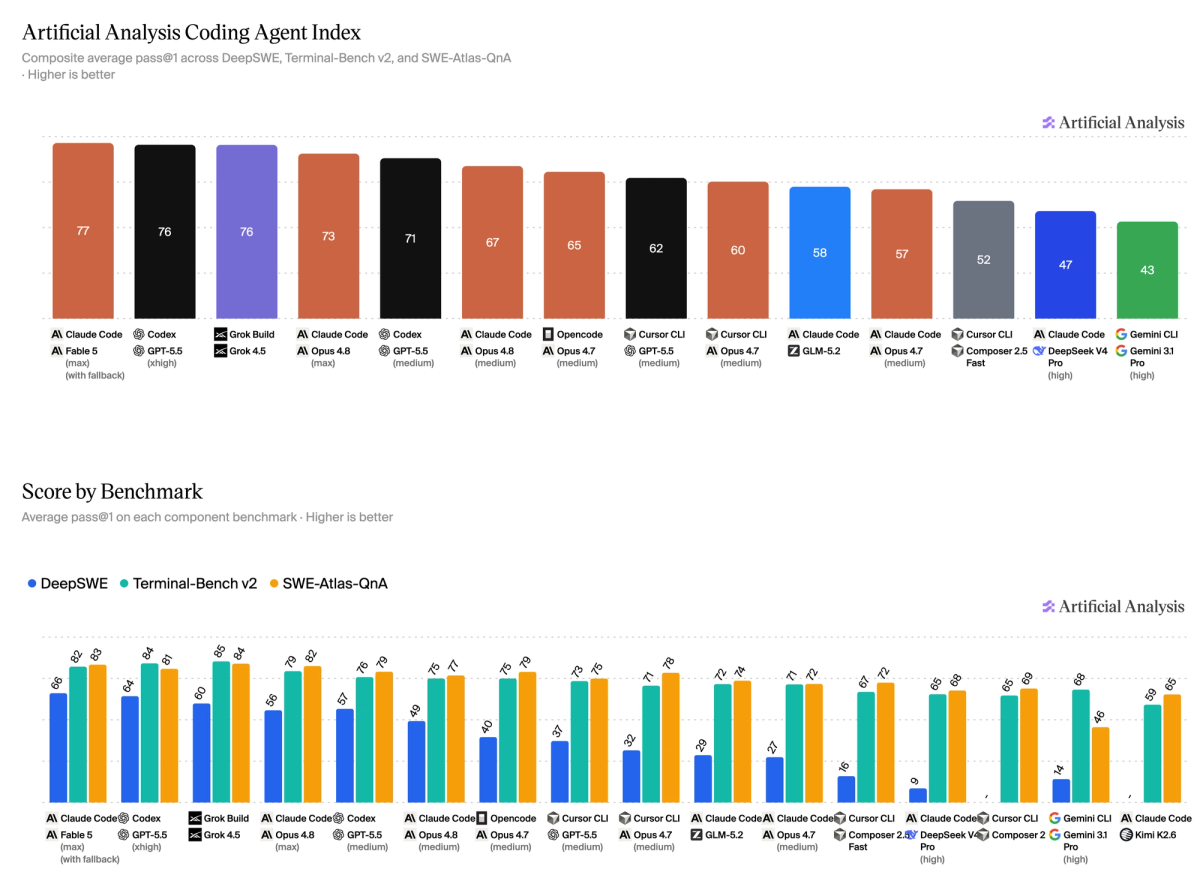
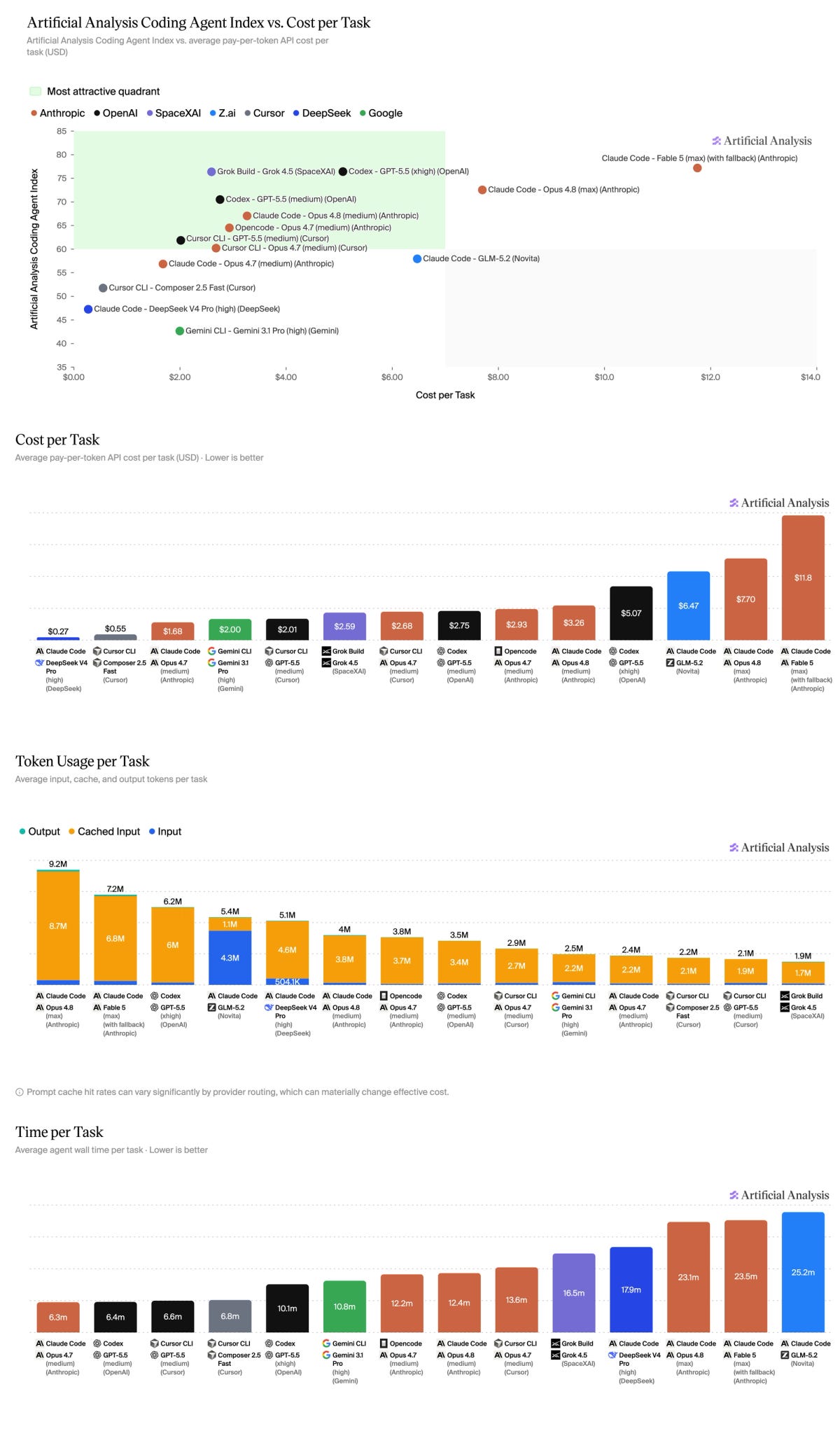
A closer look at the benchmarks puts the focus on real engineering and agent work: on Terminal-Bench 2.1, Grok 4.5 scores 83.3%, essentially tied with GPT-5.5 at 83.4% and Fable 5 at 84.3%. On DeepSWE 1.0, Grok 4.5 scores 62.0%, below Fable 5 at 66.1% and GPT-5.5 at 64.3%, but well above Opus 4.8 at 55.8%. On SWE-Bench Pro, Grok 4.5 scores 64.7%, below Fable 5 / Opus 4.8 but above GPT-5.5 at 58.6%. AA’s coding-agent lens better explains why the market cares: Grok 4.5 in Grok Build scores 76 on the Coding Agent Index, broadly in the same tier as GPT-5.5 in Codex and trailing only Fable 5 in Claude Code. But each coding-agent task costs just $2.49, below GPT-5.5/Codex at $5.07 and far below Fable 5/Claude Code at $11.80. In other words, Grok 4.5’s pitch is not the highest score on any single test, but “near-frontier + clearly cheaper + fewer tokens.”
Source: Artificial Analysis
