
Deep|LITE: Long-Term Upside Potential as a Core Player in AI Optical Interconnects
Model Update

As of March 17, 2026, Lumentum (LITE) shares are up ~76% YTD with a market cap of $44.6B, following NVIDIA’s $2B strategic investment in early March and inclusion in the S&P 500 on March 23. While near-term momentum appears largely priced in, we think OFC 2026 reinforces a more important point: the long-term architecture shift toward optical scale-up remains early—and Lumentum is structurally positioned at its center.
Management framed the growth thesis around four pillars: Cloud Transceivers, OCS, Scale-Out CPO, and Scale-Up CPO. All four are underpinned by the same core capabilities:: InP manufacturing capacity, OCS optical engines, and the UHP laser platform. Together, these define Lumentum’s structural moat.
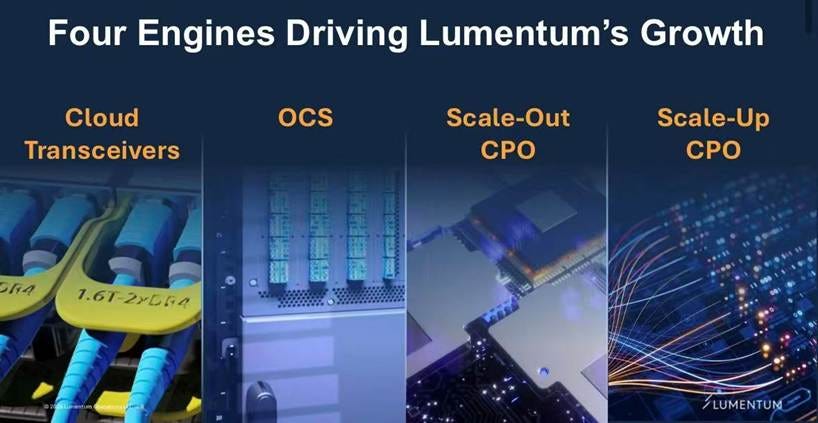
Lumentum’s four growth engines: Cloud Transceivers, OCS, Scale-Out CPO, Scale-Up CPO (Source: Lumentum OFC 2026 Investor Briefing)
InP Capacity Expansion and Supply Positioning
Lumentum’s InP manufacturing lead has crossed into true scale-driven barriers to entry: EML shipments expanded >8X from FY20 to FY26E, with plans to add an additional 50%+ EML unit capacity by end of CY26 vs. end of CY25.
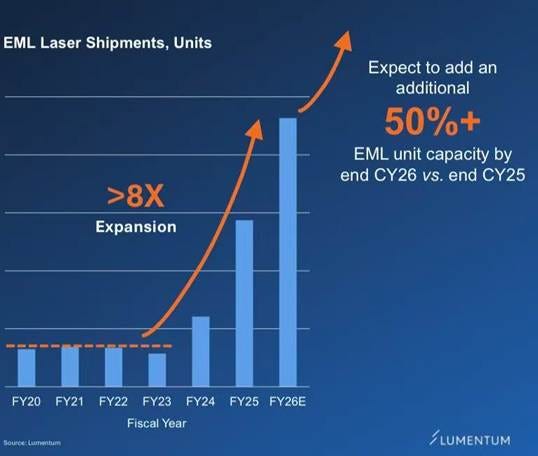
EML shipments >8X expansion FY20–FY26E; 50%+ additional capacity by end CY26 vs. CY25 (Source: Lumentum OFC 2026)
At 400G/lane and beyond, the company is advancing 400G/lane Differential Drive EML (DD-EML) as the core light source for 3.2T (8x400G). Management’s view is that SiPho does not have sufficient bandwidth for 400G/lane, positioning EML as the de facto standard in the 3.2T era. This implies EML’s share in high-speed transceivers will rise further, tightening the InP capacity bottleneck.
Management expects InP optical lane demand (EML, CW, and UHP lasers) from AI data centers to grow at ~85% CAGR from CY26 to CY30. Even applying conservative assumptions to this growth rate, the direction is clear: the industry bottleneck over the next several years will likely sit at the InP light source supply end, not at the module packaging level. Suppliers with capacity, yield, and expansion speed advantages will command significant pricing power and customer stickiness.
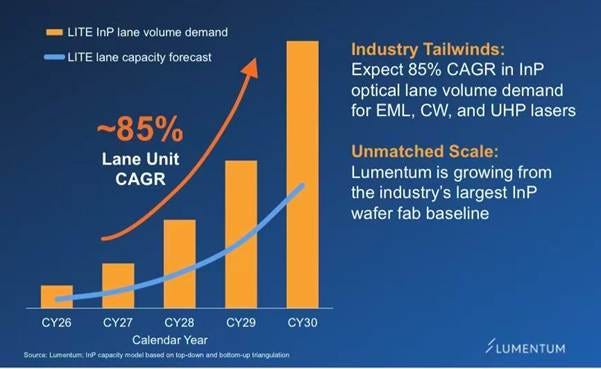
AI data center InP optical lane demand expected to grow at ~85% CAGR (CY26–CY30); Lumentum capacity forecast tracking closely (Source: Lumentum OFC 2026)
Near-Term Execution: Cloud Transceivers + OCS
On cloud transceivers, Lumentum has entered the “lead pack” of 1.6T suppliers, with volume shipments starting this summer and CW laser vertical integration expected in CQ3. Management disclosed specific timelines on yield improvement, volume loading, and vertical integration. 1.6T has moved from technology validation into production ramp.
OCS is likely the most underappreciated part of the LITE story. The company has signed a new multi-year, multi-billion-dollar OCS agreement, with current order backlog exceeding $400M to be fulfilled in 2H CY26, targeting a >$1B run rate in 2027. OCS unit CAGR is >150% from CY25 to CY28.
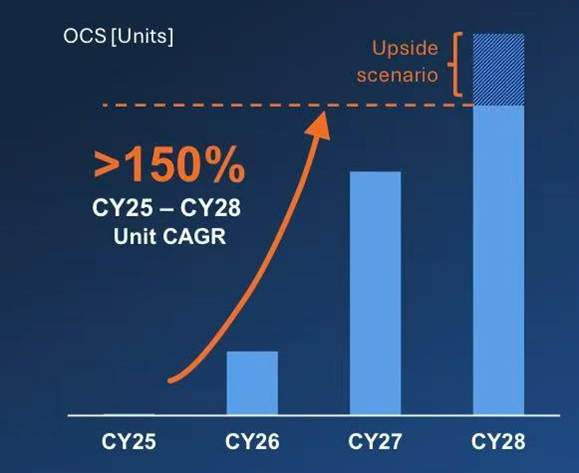
OCS unit shipments CY25–CY28 CAGR >150%, with upside scenario from scale-up applications (Source: Lumentum OFC 2026)
Lumentum’s MEMS-Based 300x300 OCS leads on insertion loss, power consumption, reliability, and high-radix scalability. Use cases extend from scale-up to scale-out / scale-across spine and super-spine. The table below shows that in scale-up scenarios, the OCS Port-to-xPU Ratio is increasing from 1.5:1 today to 2:1–10:1 in the future; scale-out/across scenarios are also penetrating, with ratios of 0.2:1 to 1:1. For every additional xPU deployed, OCS demand scales multiplicatively.
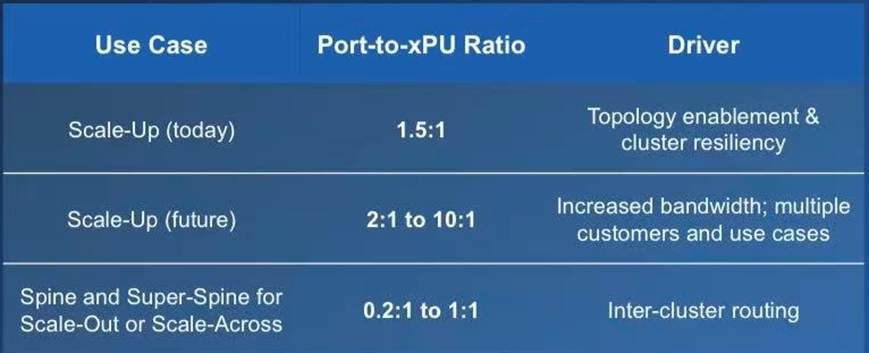
OCS use case expansion: scale-up Port-to-xPU Ratio rising from 1.5:1 to 2:1–10:1; scale-out/across scenarios also penetrating (Source: Lumentum OFC 2026)
