

We have dedicated substantial efforts and resources to investigate M365 Copilot's sales performance and gather customer feedback. In the following report, we will discuss the feedback received from Copilot's customers, the obstacles faced during Copilot's implementation, Copilot's quarterly sales figures throughout CY2024, and the projected sales for Copilot in CY2025. Lastly, we will introduce Copilot Studio, a product that may potentially surpass M365 Copilot in terms of performance and user satisfaction.
Key Functionality of M365 Copilot
Microsoft 365, or Office, accounts for over 20% of Microsoft's revenue, serving as one of the company's most crucial growth engines alongside Azure. Benefiting from its exceptionally high profit margins, it contributes nearly a third of Microsoft's overall profits, making it the company's most significant profit engine.
Following the viral success of ChatGPT in early 2023, Microsoft unveiled its M365 Copilot product in March 2023.
The initial batch of M365 Copilot primarily included Word, PowerPoint, Excel, Loop, Outlook, Teams, OneNote, and Forms.
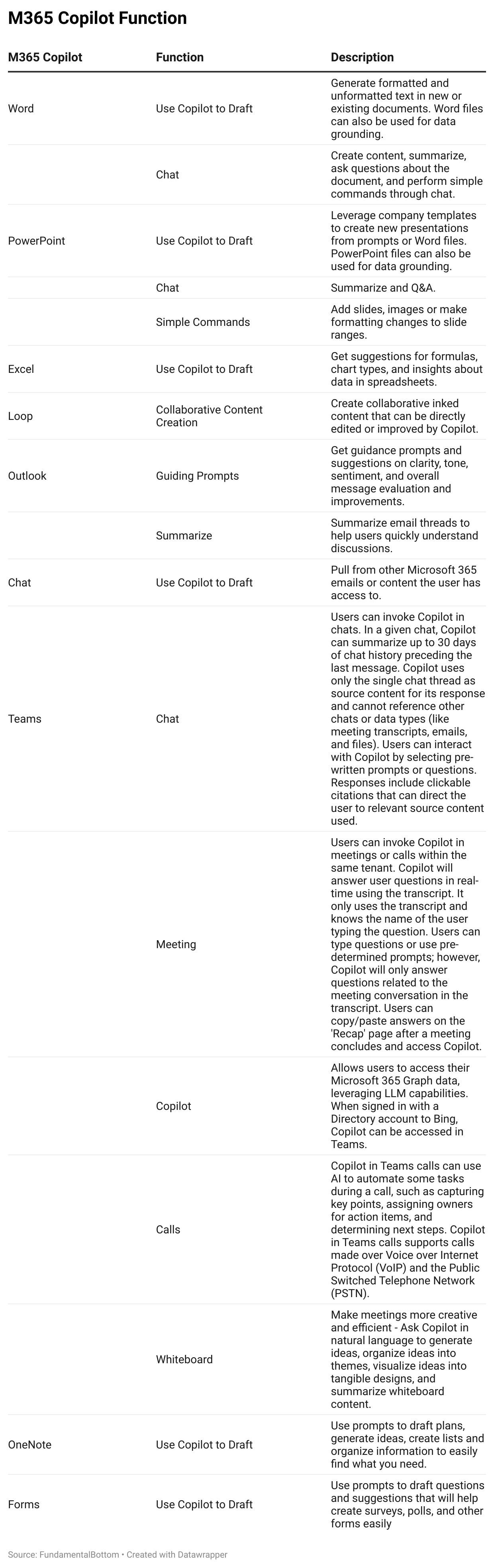
Table 1: Copilot Function
However, among all these features, users predominantly utilize the Teams Copilot and Outlook Copilot functionalities. Other Copilot features often struggle to find suitable use cases, rendering them somewhat redundant for users leveraging Excel Copilot or PowerPoint Copilot.
User Feedback on Office Copilot
SaaS companies use Net Promoter Scores (NPS) to evaluate product experience. In our sample of clients, Teams Copilot and Office Copilot tend to receive the highest scores, generally around 50%.
Conversely, the lowest-rated experiences often come from Excel Copilot and PowerPoint Copilot, typically scoring only 20-30%.
Teams Copilot Feedback (Good Experience):
Strengths: Copilot's highest-rated feature, particularly among Teams users who generally also use Office, benefits from a positive bias.It is primarily utilized for meeting notes and handling simple follow-up questions or requests.This makes it especially suitable for those who miss part of meetings or need to record and summarize meeting content.
Weaknesses: Longer question-answering sessions based on reasoning logic may contain errors (RAG functionality still needs improvement).
Outlook Copilot Feedback (Good Experience):
Strengths: Email content summarization (including multiple languages), simple email drafting (can adjust tone, formality, length, etc.).
Weaknesses: Unable to synthesize perspectives or logical reasoning from different emails within the inbox, struggling with emails requiring complex reasoning (e.g., report summaries).
Forms Copilot Feedback (Average Experience):
Strengths: The application itself sees minimal usage but can assist in generating survey and poll questions.
Weaknesses: This application is suitable for drafting simple survey templates, such as those for collecting personal information and satisfaction ratings.
However, it cannot create complex questions without human intervention being required for post-creation adjustments.
OneNote Copilot Feedback (Average Experience):
Strengths: Infrequently used application, capable of content organization, editing, rewriting, and simple Q&A. It's function is similar to Word's.
Weaknesses: Unable to adjust formatting or layout as required. Challenges remain in integrating with enterprise information and data (including non-Microsoft software data), limiting efficiency gains.
Word Copilot Feedback (Average Experience):
Strengths: Capable of content summarization, generation, and editing; can access enterprise knowledge bases via Graph for Q&A and summarization.
Weaknesses: Unable to adjust formatting or layout as required. Challenges remain in integrating with enterprise information and data (including non-Microsoft software data), limiting efficiency gains.
PowerPoint Copilot Feedback (Poor Experience):
Strengths: Can automatically generate presentations with templates from Word text (including simple tables), provide summaries, and answer questions based on content.
Weaknesses: Limited assistance for complex PowerPoint requirements; PowerPoint's native product is unsuitable for AI as many formats lack natural language definitions (e.g., "red"). Currently unable to adjust formatting or insert charts/graphics based on specific requirements.
Excel Copilot Feedback (Poor Experience):
Strengths: Can provide suggestions for simple analyses and operations (e.g., highlighting) based on standard templates, as well as formula creation prompts.
Weaknesses: Excel Cpilot 's native product is unable to handle complex tasks and is unsuitable for AI applications.The algorithms cannot comprehend the meaning behind various user-defined spreadsheet templates,such as complex financial statements, leading to potential row and column misinterpretations.
Factors Hindering M365 Copilot Adoption
Through extensive research, we have identified various issues impeding Copilot's adoption:
PPT and Word Formatting Challenges, Lack of Attractive Templates:
Due to Office's original data storage format, Copilot cannot directly edit font, color, heading, or other formatting attributes based on simple instructions, resulting in unattractive drafts for Word and PowerPoint.
Additionally, Copilot lacks pre-designed templates for Word and PowerPoint, further contributing to the unsatisfactory appearance of generated documents.
While we heard that Copilot would incorporate multimodal models to improve font, color, and heading recognition (aiding formatting), nearly 9 months have passed since this capability was first mentioned, with no significant progress.
Excel Copilot's Challenges Appear More Severe:
Currently, Copilot cannot add charts based on data or make formatting adjustments, similar to PPT Copilot's limitations.
Excel's data scenarios seem significantly more complex than Word or PowerPoint, with hundreds of common use cases (e.g., financial statements, sales management, work orders, survey statistics). In each scenario, the titles and arrangements hold unique meanings that Copilot cannot comprehend.
Furthermore, users often employ abbreviations when editing Excel, greatly increasing Copilot's comprehension challenges.
Beyond common functionality issues, Copilot also faces complex data governance challenges during deployment:
Consider a scenario where, as a fund's CIO, you believe you should have access to certain files, while a junior analyst should have access to a different set – implying the need for permission tagging across all files.
This process is extremely costly. According to our research, for a 10,000-person enterprise to deploy Copilot and annotate data governance, the cost would be around $1 million, requiring 6-9 months to complete the data tagging work. However, purchasing Copilot for all 10,000 employees would only cost $3 million annually, and clients typically only procure 10-20% of seats initially.
Clients Often Struggle to Measure Copilot's ROI:
Unlike Salesforce Agentforce or ServiceNow Assist, which offer clear workflows, clients are unsure how to quantify Office Copilot's impact on employee productivity.
Although Microsoft introduced Viva Insight in CY2024Q2 to help clients measure ROI, customers generally find it unhelpful.
Microsoft continues efforts to provide more ROI measurement tools, but progress remains limited.
Unions Emerge as a Significant Obstacle to Copilot Adoption:
The powerful European Works Council has mandated that enterprise managers cannot use M365 Copilot to collect individual employee performance data for evaluation purposes, such as tracking an employee's weekly writing output. Consequently, some enterprises have encountered obstacles in purchasing Copilot seats or activating procured seats.
We believe this is not a long-term impediment and may be resolved within a few months to a year. Enterprises need to demonstrate to unions: 1) Internal policies have been implemented to prevent prohibited practices, and 2) The benefits of using Copilot far outweigh the drawbacks.
The above factors have contributed to Copilot's persistently low activation and active user rates, falling short of client expectations:
For most of 2024, clients purchasing Copilot would activate less than 60% of accounts, with the remaining accounts left unactivated.
Among activated accounts, long-term active user rates (MAU) hovered around only 40-50%.
Multiplying these two metrics implies that only about 30% of clients are genuinely utilizing Copilot.
M365 Copilot Progress in CY2024Q1
Key Insight:
According to our research, Copilot reached 2.5 million seats in CY2024Q1.
The vast majority originated from its Early Access Program (EAP) launched in CY2023, with over 95% of the initial 1,000 test clients becoming Copilot enterprise customers.
Notably, our research even suggests that Microsoft may be reluctant to promote Copilot due to its underwhelming activation and active user rates.
We have compiled our research notes:
A Microsoft partner expert mentioned that the EAP was Copilot's primary growth driver, stating, "Many large clients from the EAP signed three-year contracts, committing to over 5 million Copilot seats within 3 years. Currently, there are over 2 million paid users, with an estimated 200,000-300,000 seat increase per quarter."
Another partner expert noted, "Recent sales momentum has slowed, possibly due to low activation and active user rates. I believe Microsoft aims to prioritize successful case studies with a few large clients first, anticipating accelerated sales growth in CY2024Q3."
Another channel expert corroborated this observation, stating, "Recent sales momentum has slowed, possibly due to low activation and active user rates. Microsoft is intentionally controlling new client sales. I believe they want to prioritize successful case studies with a few large clients, improving activation and active user rates before accelerating sales in Q3."
Regarding the low activation and active user rates, a partner expert mentioned, "For large clients, the paid seat activation rate is less than 40%, as many executives signed significant contracts without well-defined application scenarios, suitable audiences, or account provisioning plans. Small and medium-sized enterprises (SMEs) are more flexible in their seat procurement, resulting in higher activation rates."
Another partner expert believed comprehensive training could boost active user, stating, "Currently, enterprise weekly active user is around 50%. However, enterprises with proper employee training can achieve 70% active user"
M365 Copilot Progress in CY2024Q2
Key Insight:
The major bottleneck of low activation rates was essentially resolved in Q2, improving from 50% to around 60%, which is not far from the ideal 70% target. This improvements indicates that many enterprises have confirmed use cases and made progress in data asset availability, enabling broader application rollouts. With higher activation rates, an increase in active users is expected, driving further organizational Copilot penetration.
After resolving activation issues, Microsoft restarted sales efforts in June, reaching over 4 million seats in Q2 – consistent with the 60% QoQ growth mentioned in their earnings call.
Additionally, Copilot opened non-English markets in Q2 through optimizations for smaller languages.
Microsoft's consumer DNA remains weak, with Copilot's individual customer base currently around only 100,000 seats, unlikely to contribute significantly in the short term. The AI PC concept could drive volume gains in the long run but at pricing far below the current $20, limiting its revenue contribution.
We have compiled our research notes:
AI PC Impact: A former cloud vendor partner expert stated, "AI PCs are currently primarily sold through Microsoft's Surface Laptop retail channel, but Microsoft's consumer DNA is inherently weak, so the volume is still minimal. Long-term potential stems from Microsoft partnering with other OEMs like HP and Dell to pre-install Copilot on their machines, targeting the consumer channel. This would likely be a B2B deal at much lower pricing due to lower individual usage frequency compared to enterprise users. For volumes below 10,000, pricing could be around $10, with larger volumes receiving steeper discounts."
Activation Rates: In April, the activation rate (activated seats/purchased seats) was only around 50%, posing a bottleneck. Improving activation rates became a key focus in Q2 sales efforts, including promoting Viva Insights to help enterprises quantify Copilot's ROI. According to two partner experts, "The current activation rate has reached 60-70%" and "The activation rate was around 65% by the end of Q2, with educational institutions like universities and SMBs achieving higher rates of around 80%, while large enterprises lagged due to pressures from European unions and strict compliance requirements. The ideal state is around 70%, striving for every enterprise to achieve over 70% activation."
Sales Progress: A cloud vendor partner expert mentioned, "After the activation rate issue was alleviated, sales efforts accelerated again in June." Another channel expert also stated, "Q2 sales momentum slowed due to low activation rates but should regain traction in Q3." Two cloud vendor partner experts familiar with sales reported, "Current Copilot seat count is around 4.5 million" and "By the end of June, enterprise Copilot licenses were approaching 4 million, with around 100,000 individual Copilot Pro seats, resulting in an ARR of approximately $1.2-1.3 billion."
One cloud vendor partner expert noted, "Japan is currently a rapidly growing market for Copilot, surpassing China and India, contributing nearly 10% of global Copilot revenue. This may be because Japanese users were previously dissatisfied with many Microsoft products, so the Copilot team emphasized user satisfaction in Japan, actively resolving issues, including language problems, resulting in positive word-of-mouth. Japanese users also exhibit higher weekly retention rates compared to other regions (40% vs. 30%)."
Beyond Japan, Europe is also undergoing optimization for smaller languages. An expert stated, "Recently, progress has been slower in many European countries due to complex legal and regulatory frameworks. Microsoft is also expending its focus to new markets outside the US. A key factor for successful penetration in new markets is robust language support. This is expected to roll out in Q3, addressing many customer dissatisfaction issues, such as the subpar English-UK experience compared to English-US, and the underperformance of French-Canada."
ROI Dashboard Tool VIVA Insight: An expert mentioned, "In terms of the go-to-market strategy, Microsoft is also actively bundling Copilot with other products for joint sales, which can drive sales of niche products. For example, when selling the Viva Suite priced at $12/month, bundling it with Copilot at $32 offers an overall 30% discount from the original price."
Sales Conversion and Customer Profile: A cloud vendor partner expert stated, "Of the current 4 million enterprise Copilot seats, approximately 90% are E3/E5 users, with around 90% of seats coming from large enterprises and organizations, representing roughly 11,000 institutions. The total addressable market is around 100,000 institutions (i.e., 90,000 are in the long tail)." Regarding sales priorities, the expert mentioned, "Among Office 365 E3/E5 users, around 100 million seats come from large enterprise clients, with the rest being in the long tail. Microsoft's current focus is converting these 100 million large enterprise users into Copilot users. Most large enterprises have already adopted or are testing Copilot, but penetration remains low. The next few quarters' emphasis is on driving enterprises with under 300 purchased seats to buy over 1,000 seats. Assuming a 50% conversion rate among these large enterprises' 100 million seats, Microsoft could achieve its interim goal of 50 million seats."
M365 Copilot Progress in CY2024Q3
Key Insight:
The Wave 2 product updates will optimize some applications, with the introduction of Copilot Agent being the most significant, potentially accelerating penetration. Microsoft will continue rolling out further updates to enhance the product experience.
M365 Copilot is expected to reach nearly 6 million enterprise seats in CY2024Q3, an increase of less than 2 million seats compared to CY2024Q2.
