After speaking with many institutional investors attending the event, the consensus was that this year’s ASPARAS Summit had the highest in-person attendance in nearly eight years, clearly reflecting the positive correlation with Alibaba’s recent stock rally.
Synthesizing all the key takeaways, the summit delivered three major messages.
Accelerated AI Investment and Long-Term Infrastructure Roadmap
Alibaba’s leadership emphasized that the company’s commitment to AI infrastructure investment will remain highly aggressive in the coming years. CEO Eddie Yongming Wu made two pivotal statements:
Alibaba Cloud plans to advance RMB 380 billion in AI infrastructure investments between FY25 and FY27, with additional capital expenditure expected beyond that.
In preparation for the AGI era, Alibaba expects its global data center power consumption in 2032 to be 10x higher than in 2022.
Given that Alibaba’s total power load in 2022 was roughly 1 GW, this implies a scale of around 10 GW by 2032 — an average incremental load of ~1 GW per year. Since the cost per watt of compute varies by GPU generation, it’s difficult to precisely project annual capex acceleration. Management deliberately framed this target in terms of power consumption, signaling strong intent to the industry while avoiding overly specific capex disclosures that could distort valuation expectations for supply-chain players, and to prevent investors from over-interpreting the potential revenue growth trajectory.
Overall, the takeaway is clear: Alibaba intends to remain a long-term and committed investor in compute capacity, underpinning sustained growth for Alibaba Cloud.
“Panjiu 128” SuperNode: Potential Efficiency Gains and Margin Expansion
Alibaba unveiled its next-generation Panjiu 128 SuperNode — a high-density AI server cluster capable of integrating up to 128 GPUs per rack, a major architectural leap from the previous 16-GPU design. This platform is designed to support future-scale workloads including large model training, inference, and multimodal AI.
The significance extends beyond GPU density. The system features a fundamental architectural redesign across hardware topology, CPU-GPU decoupling, interconnect architecture, thermal engineering, and China’s ecosystem compatibility. Industry experts expect large-scale deployment to begin in CY2026.
Alibaba is also accelerating internal development of PPUs and custom ASICs to mitigate geopolitical restrictions on NVIDIA GPUs in China, ensuring its long-term AI roadmap remains achievable.
Key architecture upgrades of Panjiu 128 include:
Backplane-free orthogonal design: Eliminates cable trays, reducing signal loss and crosstalk.
Fault domain isolation: Enables hot-swap replacement at the tray level without downtime.
CPU-GPU decoupling: Allows flexible CPU:GPU ratio tuning and capex optimization.
Interconnect flexibility: Supports NVLink ⇄ UALink, reducing single-vendor lock-in.
Estimated operational and financial benefits:
MTTR reduction: From 4–8 hours to ≤15 minutes → 10–15% opex savings.
P99 latency jitter: ≤10% → 5–10% effective throughput improvement.
GPU lifespan: +25–40% → significant depreciation leverage.
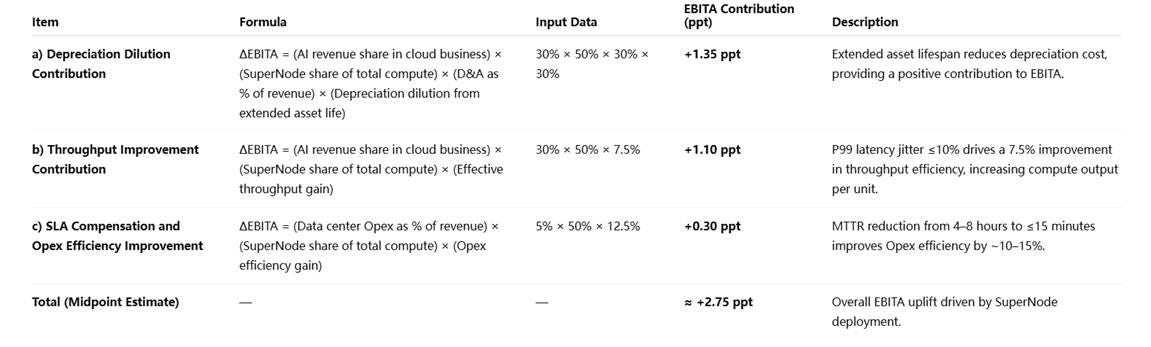
Based on mid-range estimates, Panjiu 128 deployment could deliver a ~2.75 ppt EBITA margin uplift for Alibaba Cloud, broken down as follows:
Depreciation dilution (longer asset life): +1.35 ppt
Throughput gain: +1.10 ppt
Opex efficiency: +0.30 ppt