
Deep|ALAB:Scale-up, Gearbox, AWS, AMD, MSFT

FundamentalBottom is officially rebranding to FundaAI.FundaAI provides AI Invest OS, including AI Agents, equity research reports, and research data.
Click here to join the FundaBottom AI Beta Testing.
If you're already a paid subscriber to our Substack, this product is completely free for you.
Company Overview
ALAB's Positioning and Technological Foundation
Company Introduction and Business Evolution
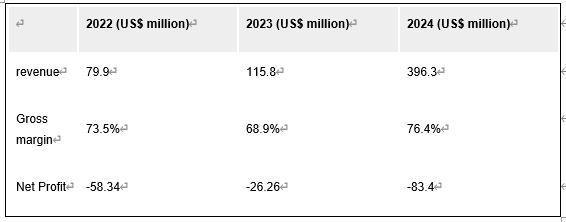
Astera Labs (ALAB) was founded in 2017 by three former Texas Instruments executives, including Jitendra Mohan. The company has grown rapidly since its inception. From 2022 to 2024, the company's revenues were US$79.9 mn,US$115.8 mn,US$396.3 mn;Gross margins were 73.5%, 68.9%, 76.4%. Net profit were US$-58.34 mn, US$-26.26 mn, US$-83.4 mn. The company was listed on the NASDAQ on March 20th, 2024.
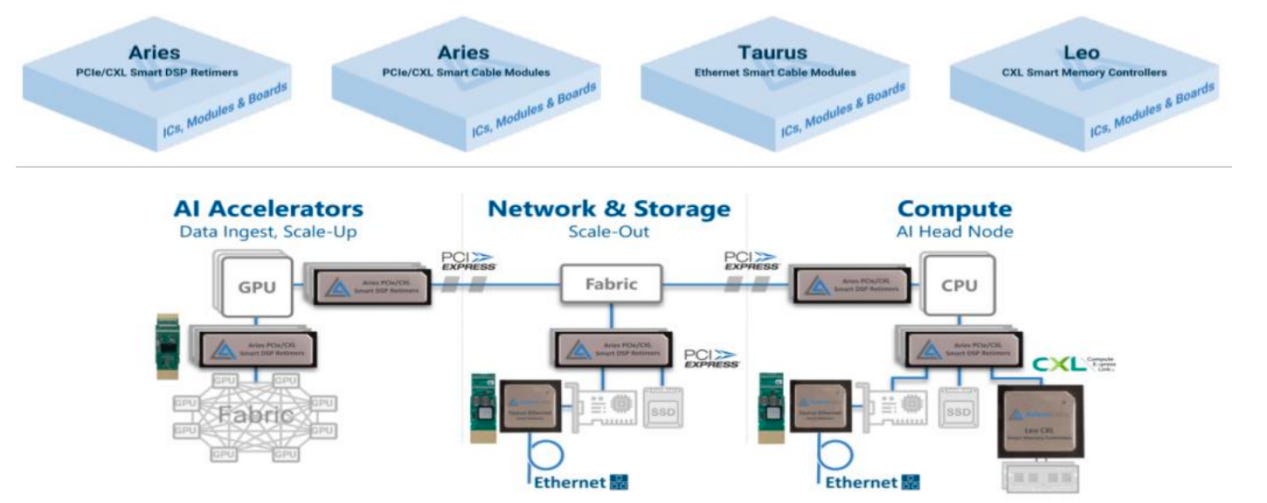
Initially, the company's core business consisted of products such as Retimers, AECs, CXL, and GPU-to-CPU switches, with a product line focused on solving connectivity and memory bottleneck issues related to AI in data centers:
Retimer chips: The Aries business line covers the company's PCIe Retimer chips. Retimers digitally restore degraded high-speed signals and retransmit data, enabling higher data bandwidth;
AEC:Taurus is the company's Active Electrical Cable (AEC) module business, which primarily extends transmission between servers and switches via Ethernet;
CXL memory connectivity controllers: The Leo product series is the company's memory connectivity controller business based on CXL technology, mainly aimed at solving the "Memory Wall" problem.
Recently, market focus has shifted. The Scorpio P series and Tarus product lines contributed over 10% of the company's revenue in 2Q25, and ALAB is also set to launch its custom Scorpio-X switch chip. Future growth in this business will primarily come from collaborations with two key customers: one is the custom NeuronLink switch chip for AWS's Trainium series, and the other is the custom UALink switch chip for AMD's MI400 series.
Core Technical Strengths and Market Positioning
ALAB's core technical strength lies in its unique positioning around open interconnect protocols. In the current AI accelerator market, NVIDIA has built a powerful closed ecosystem with NVLink, while ALAB has avoided direct competition by becoming the only supplier in the market capable of providing a scale-up switch solution based on the open PCIe and UALink protocols. This market positioning has enabled it to establish deep cooperative relationships with non-Broadcom ASIC vendors such as AWS and AMD.
By focusing on a market position of open protocols, its products are more tailored to meet the demand for large-scale, cross-node interconnection in the non-NVIDIA ecosystem, rather than directly competing with NVIDIA on intra-chip bandwidth.
It is worth noting that Annapurna Labs is a microelectronics company under AWS that focuses on designing custom chips for AWS, including the Graviton CPU series and the Trainium and Inferentia ASICs for machine learning. ALAB's collaboration with AWS is, in fact, a deep partnership with Annapurna Labs.
Core Partnership Model: Annapurna Labs is responsible for designing the Trainium AI chip, while ALAB provides critical interconnect solutions for these chips. This partnership reflects the chip industry's shift towards a "building-blocks-centric" development model, where companies like Annapurna Labs focus on core computing chips and collaborate with suppliers like ALAB, who have expertise in specific areas (such as interconnects), to accelerate time-to-market.
Specific Technical Complementation: Chips designed by Annapurna Labs, such as Trainium 2, use a proprietary chip-to-chip interconnect technology called NeuronLink. ALAB has customized the Scorpio-X switch chip for this purpose, which can be configured as a NeuronLink switch to support Trainium's rack-scale expansion network.
High-Level Collaboration: In the future Trainium 4 project, ALAB will collaborate with Alchip to co-design the I/O die chip. In this partnership, Alchip will be responsible for the compute die part, while ALAB will leverage its comprehensive technical advantages in both retimers and switches to design the I/O die. This system-level deep collaboration is based on AWS's trust in ALAB's technical capabilities.
Personnel Connection: ALAB board member Manuel Alba previously served as a director at Annapurna Labs.
Furthermore, the company's technical advantages are reflected in the following aspects:
Open Protocol Compatibility: ALAB's solutions are based on open standards, which allows them to be seamlessly integrated into diverse hardware ecosystems, providing customers with greater flexibility and scalability than closed systems.
End-to-End Product Capability: ALAB has a technical team that works on both retimer and switch chips simultaneously. This cross-product line technical capability is crucial in system-level integration projects like the I/O die, as it ensures seamless collaboration between different chips and effectively avoids potential compatibility issues. This unique comprehensive ability is a key reason why the company was chosen by AWS to co-develop the Trainium 4 I/O die solution.
Huge Market Potential: With its exclusive position in the open protocol space, ALAB is poised to win more customers beyond AWS, such as other non-Broadcom ASIC vendors like AMD and MSFT.
In-depth Analysis of Technology and Product Lines
Detailed Explanation of the UALink Protocol
Origin and Technical Characteristics
