
Research|Apple intelligence – ultimate winner in AI? - Part1
Overview, Personalized Agent, Developer Ecosystem, Architecture, Entry Point, Technology, Business Model

Apple Intelligence Overview
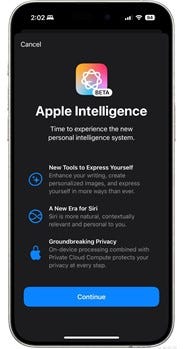
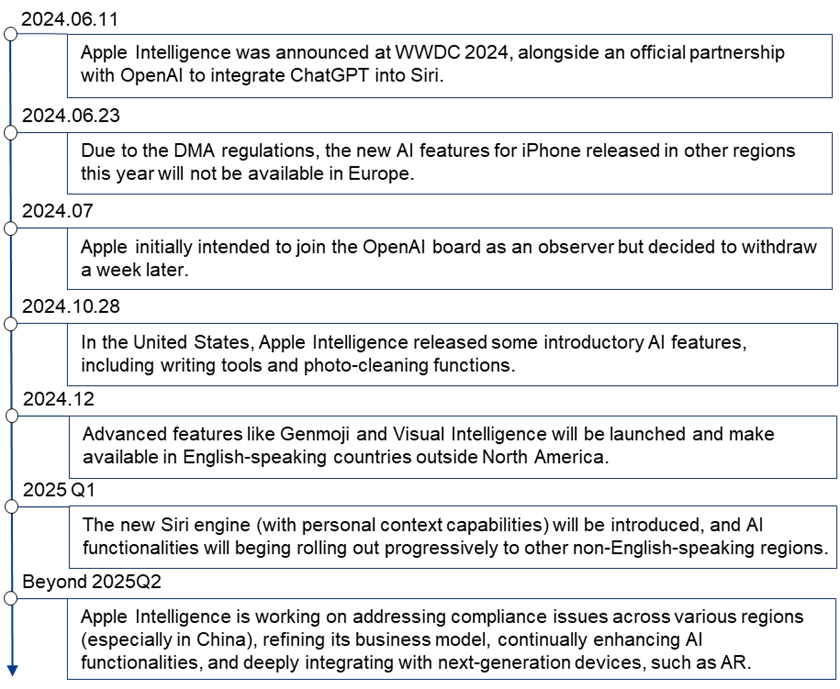
Apple Intelligence represents a significant advancement in Apple's integration of artificial intelligence (AI) across its product ecosystem. Announced at the Worldwide Developers Conference (WWDC) in June 2024, this initiative underscores Apple's commitment to enhancing user experience through AI-driven features. The rollout began with the release of iOS 18.1, iPadOS 18.1, and macOS Sequoia 15.1 on October 28, 2024, introducing capabilities such as Writing Tools, enhanced Siri functionalities, and advanced photo editing options. These developments mark a pivotal moment in Apple's strategy, aiming to seamlessly integrate AI into daily user interactions while maintaining a strong emphasis on privacy and on-device processing.
Figure 1. Key Milestones and Challenges in the go-to-market of Apple Intelligence
From Apple's standpoint, its goal is to develop Apple Intelligence into an interface that integrates artificial intelligence with applications. By integrating the Intent API and Ferret UI, Apple Intelligence can achieve cross-application calls and automated operations. Furthermore, Apple hopes it can serve as a major gateway into the era of artificial intelligence.
Apple has long been laying the groundwork with its Intent API, which exposes software information and functionalities through this API, providing developers with tools to integrate AI features. This strategy could potentially position Siri as a key traffic gateway in the new generation, thereby strengthening Apple's control over its entire ecosystem. The foundation of the entire automation solution includes using the full set of Intent APIs for scheduling, the Ferret UI for screen reading, and intent recognition based on multimodal large language models. Additionally, Apple hopes to create a data feedback loop relying on the existing reinforcement learning framework. Through continuous use and data collection, Apple can continuously optimize the model. Theoretically, Apple Intelligence has the potential to serve hundreds of millions or even a billion users, continuously improving model performance through the feedback loop. This kind of automated invocation may change the way third-party software collaborations work. Of course, antitrust and regulatory restrictions also pose challenges to the promotion and progress of product features.
As for Apple's model capabilities and layout, despite showing strong competitiveness in the iteration and capabilities of on-device models, Apple is still deeply investing in cloud technology and hardware, and the team is very strong. Apple has recruited a large number of talents from companies like Google, and its current level may be comparable to Meta, although there is still a gap compared to first-tier enterprises like OpenAI, Google, or XAI. The team's recent papers demonstrate rapid progress in enhancing the capabilities of on-device models. Currently, the iteration speed of models mainly depends on the scale of computing power. For example, Apple's deployment of 10,000 GPU cards can enable the capabilities of on-device models to double every one or two months, so the capability iteration speed of on-device models is very rapid. As we mentioned, the essence of computing power lies in scale, and greater computing power means stronger models can be developed. We believe that at least on the device side, Apple has the potential to be in a leading position. Apple's AI team mainly comes from Google, and the internal goal is to catch up with technologies like GPT-4O. Apple's deep technical accumulation in AI and annual budget of tens of billions of dollars are actively supporting this goal.
On-device models are developing rapidly, and their capabilities can double every few months on average. Apple is still in the early stages, and there is huge room for growth and optimization in both technology and products. We believe that the improvement of model capabilities will be jointly driven by stronger computing power, better teacher models, better data, and more refined model control. Apple's models in text generation and summarization are already close to the level of GPT-3.5, and in the near future, they may fully reach the standard of GPT-4O mini. In the short term, the parameters of on-device models are between 3 to 7 billion, and they can already achieve basic text editing, intent recognition, and task scheduling. In the mid-term, with further iteration of NPU and hardware, the scaling up of models and the enhancement of on-device small-model capabilities may achieve more complex functions. For example, OpenAI's latest reasoning model GPT-O1, including its smaller version GPT-O1 Mini, theoretically can run entirely on-device, making future on-device applications more diverse and reducing dependence on cloud models.
Architecture of Apple Intelligence
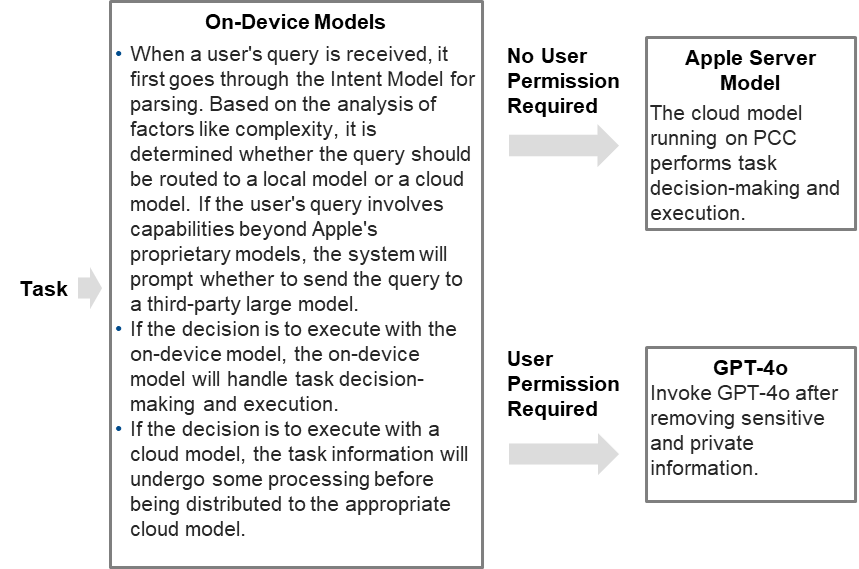
Apple Intelligence consists of a three-tier dynamic architecture made up of on-device models, servers, and third-party large models (such as OpenAI's ChatGPT-4o), providing high architectural flexibility. The architecture of self-developed models is as follows:
On-device Models:
oApple On-Device: Approximately 3 billion parameters; runs directly on terminal devices like phones, with an inference precision of 2-4 bits.
oIntent Model: Deployed on terminal devices, with a smaller parameter count, used to determine which model should execute a task. If the on-device model's performance is suboptimal, a task model replacement mechanism is triggered. Specifically, using a mechanism similar to a confidence score, if the score is too low, the task is transferred to a more capable model for execution.
Server Model:
oApple Server Model: Approximately 7-13 billion parameters; this model can operate through private cloud computing (PCC) and runs on Apple's servers, with an inference precision of int8. In the future, PCC will consist of dozens to hundreds of experts, forming a 300-billion-parameter Mixture of Experts (MoE) model.
Figure 2. Overall architecture of Apple intelligence
Apple’s Strategic Advantage as the Personal Assistant
One of Apple's main goals is to transform the iPhone into everyone's personal assistant—a personalized agent. We believe this goal has great potential for realization, especially due to Apple's integrated software and hardware design and clear usage scenarios. Globally, especially in the United States, Apple has covered the largest user base, including high-value customer groups. This makes the iPhone a platform very conducive to data accumulation. In addition, Apple's device-cloud integrated AI phone strategy is expected to mainly materialize in the high-end phone market. Due to the high demand for on-device computing power, Apple's device-cloud integration advantage in high-end products is very obvious, which may make it a benchmark product in the market.
The second important advantage is the overall system integration. The self-developed device-cloud integrated computing power significantly enhances competitiveness and can reduce engineering costs through unified deployment tools. The software and hardware integration strategy may achieve integration from models, operating systems, hardware to permissions, strengthening control over software development through a closed-source ecosystem. This integration not only improves efficiency but also enhances the market competitiveness of Apple's products, providing users with a seamless and highly personalized experience.
In terms of hardware, Apple's A17 Pro and above iPhones and M-series chips have been designed to support Apple's strategy. Whether they can support Apple Intelligence mainly challenges memory and bandwidth computation, and more crucially, how to position Siri as the core entry point of Apple Intelligence in the future. Apple expects users to first initiate requests to Siri, which will be sent to specially trained models for processing and selecting appropriate applications to execute tasks. This process covers application integration and task scheduling, ultimately executed through Apple Intent and returning the results to the user.
In future AI application scenarios, Apple, with its strong software and hardware integration advantages, can create an intelligent ecosystem with unique personal system functions. This advantage is not only recognized within Apple but also attracts the attention of competitors like Google and Meta. Apple's overall strategy shows that it not only focuses on high-end intelligent hardware ecosystem layout but also pays attention to the commercialization of AI. As shown in past fields like autonomous driving and robotics, the high-end application of technology does not always bring direct benefits, and scenario-based applications and commercial implementation are the key. On-device AI, due to its controllability and rapid deployment potential, is believed to help realize the commercialization of relatively simple scenarios like robot vacuum cleaners.
Apple's advantage also lies in the high-frequency use of its devices and the convenience of data collection, especially iPhones and other high-end phones not only have a wide user base but Apple users are more receptive to AI-related features. Apple's device-cloud integration capabilities, self-developed chips, and strong developer ecosystem give it a significant system-level integration advantage in the competition, which is difficult for other manufacturers to replicate.
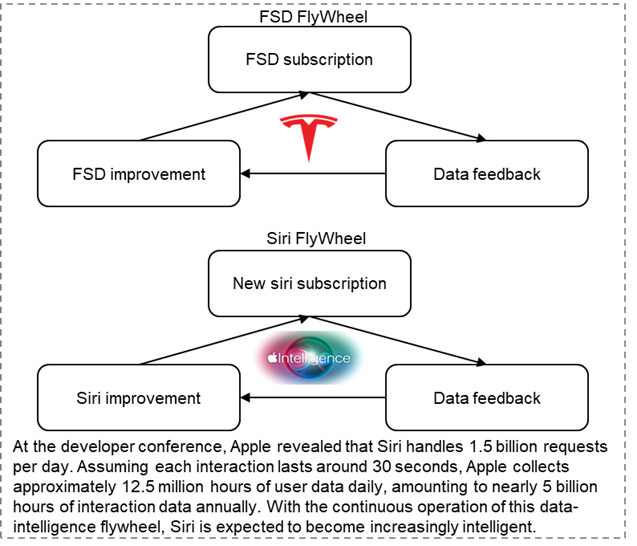
Siri's capability enhancement model is similar to Tesla's data flywheel model, continuously improving service quality through user feedback. As users subscribe to the new Siri, it will become more intelligent and personalized. Apple will collect user personalized data and feedback from multiple sources, continuously optimizing the model to improve service accuracy and personalization. Screen awareness technologies, such as FairyGUI or auto GLM screenshot recognition functions, are also similar to enhanced screen-reading capabilities.
Figure 3. Data flywheel of Siri
So the core is still that the Apple Intent tool will allow Apple to customize at the bottom of the operating system and API level, achieving application information reading and function calls, thereby building a complete ecosystem. This may lead to future Apple Copilot or Apple's personal agent becoming the core entry point. Apple's advantage lies in controlling key technologies and user experience through a self-customized closed ecosystem. Some third-party applications may be willing to integrate their APIs into Apple's system, and this cross-application information invocation and automated operation will further strengthen the functionality and attractiveness of Apple devices.
Figure 4. Siri request with Apple Intelligence
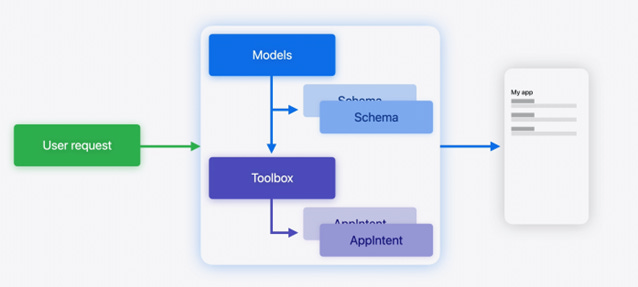
Developer Ecosystem Construction
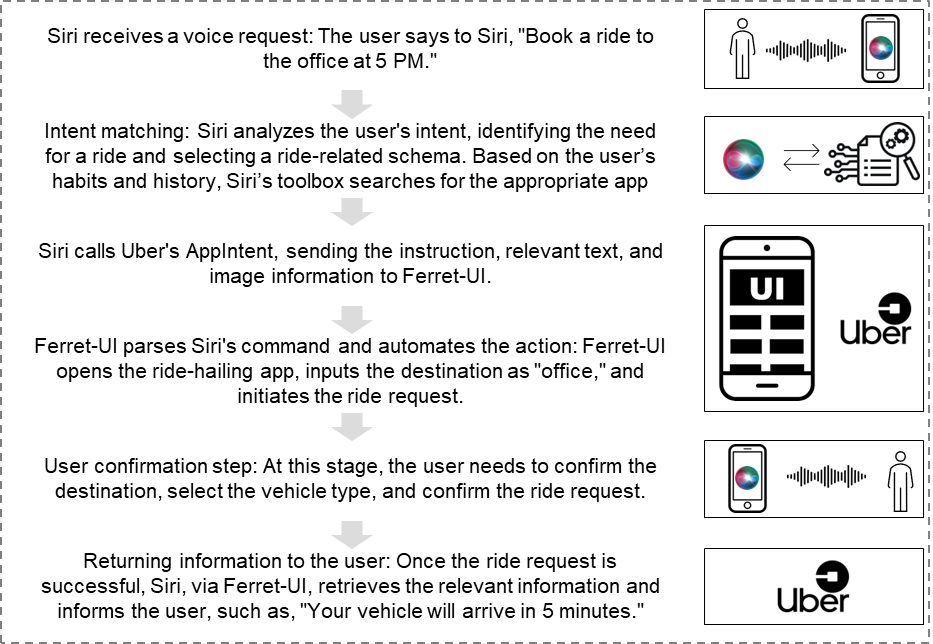
To this end, third-party applications need to proactively expose data to the intelligence layer, including semantic indexing and application intents toolboxes, so that they can integrate with Apple's ecosystem. However, this raises antitrust issues, involving concerns about traffic entry points and unfair competition. For example, specific to ride-hailing applications, users may only need to simply state their requirements, such as: "I need to go to the company at a certain time." Siri can automatically handle this request according to user preferences, including selecting the car model and considering company reimbursement policies. This process integrates API calls from various applications through Ferret UI, such as Uber or Lyft, and can automatically complete destination input and vehicle dispatch. In addition, Android devices also support similar APP intent APIs but may not be as flexible and integrated as Apple's closed ecosystem.
Figure 5. How developers collaborate with new Siri and Apple Intelligence. Taking Uber as an example
For Apple, deploying advanced agent functions like task automation is very cautious, especially those that directly affect user experience. This is because if the initial user experience is poor, they may not continue to use the feature. Siri's history is an example; despite having a huge user base, its daily call volume is relatively low, reflecting the general user perception of its practicality. The requirements for to-C products are relatively high.
Apple Intelligence's Future Scaling Path
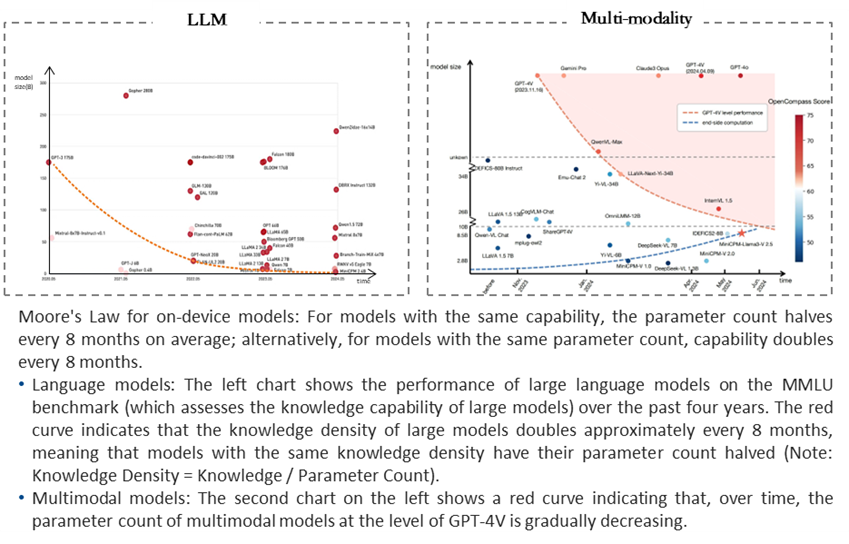
In terms of on-device AI, Apple's small-model capabilities can continue to improve; in the future, many tasks are expected to be completed locally. This trend may gradually replace the large-model ecosystem with on-device processing and intelligent entry points. Apple's strategy has always been to build a model-centric ecosystem, promoting the development of Personal Assistant or Personal Agent by combining resources, traffic, paid features, etc.
Our research found that whether it's OpenAI's CEO Sam Altman or other industry experts, many people believe that companies with core entry points are more likely to eventually win. Apple's strategic roadmap also clearly shows their short-term goal: to improve model capabilities to GPT-3.5 or similar levels, with PCC's performance close to GPT-4O and third-party iterations reaching GPT-5 capabilities.
Figure 6. Scaling law of “small models”
In the short term, Apple's killer app is definitely still in the form of Copilot, helping users complete specific tasks, improve efficiency, while covering some entertainment functions. The interaction methods are mainly clicks, text, and voice input, and AI integration will provide a more convenient user experience. For example, text rewriting, writing assistance, integration with input methods, and other application scenarios can simplify user operations and make interactions smoother.
In the mid-term, as the on-device model capabilities approach the level of GPT-4, PCC reaches GPT-5, and third-party models move towards GPT-6, Apple's applications may achieve a higher degree of automation in vertical scenarios. At this time, the interaction form of Siri as the core entry point will also further evolve. Users may no longer rely on traditional keyboard input but use more natural voice interactions to use devices. Apple can leverage this advantage to provide users with comprehensive personal planning functions, meeting various needs from itinerary arrangements to work task planning, and even directly calling applications to execute operations.
In the long term, as on-device and cloud models gradually approach the level of AGI (Artificial General Intelligence), Apple's devices will truly become everyone's "personal assistant." In this scenario, users' intelligent devices will be able to automatically complete various tasks; users only need to set goals, and the devices will automatically complete tasks according to preset plans. This highly intelligent agent can predict and respond to user needs, continuously simplifying human-computer interaction, making users' daily operations more seamless and automated, truly realizing comprehensive assistance of AI technology in personal life.
As for Apple's cooperation with third-party large models, it currently has the flexibility of a three-layer architecture, making cooperation more flexible. In the future, Apple may adopt an application method similar to Poe, giving users the choice of models and selecting different large models according to the specific conditions of different regions. In terms of software and hardware integrated interaction forms, we believe that the existing mature hardware forms may remain unchanged, that is, AI technology will still be implemented on phones and PCs in the form of Copilot first. But in the mid-term, as on-device model capabilities improve, it may be more deeply integrated with systems and software to achieve more automated Auto Pilot. Apple will definitely use Siri as a traffic entry point and may shift the interaction form from initial touch clicks and text input to voice interaction combined with multimodality.
